

Dry Needling in College Station
Thin monofilament needles placed directly into muscular trigger points, releasing chronic tension that massage and stretching cannot fully reach.
Not acupuncture. A completely different mechanism.
Dry needling is the insertion of thin, solid monofilament (filiform) needles, without any medication or liquid injectate, into neural, muscular, and connective tissues including ligaments, tendons, fascia, scar tissue, and peripheral nerves to treat neuromusculoskeletal pain and movement dysfunctions.
Unlike acupuncture, which is based on meridian theory, dry needling targets specific anatomical structures based on clinical examination findings. Trigger point release is only part of what it treats here. Our therapists also use it on ligaments, tendons, scar tissue, and peripheral nerves, and it has become one of the services College Station patients specifically seek us out for.
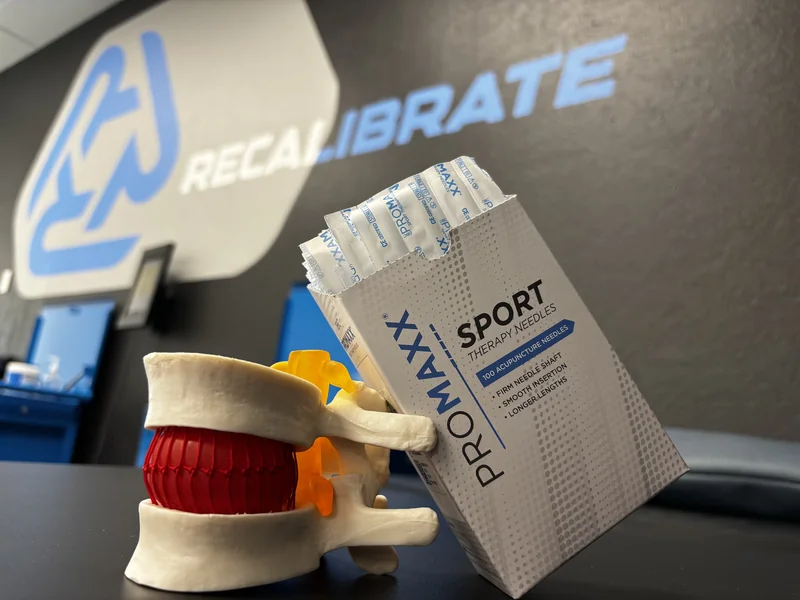
Brief discomfort, lasting results.
Trigger Point Assessment
Your therapist identifies active trigger points through hands-on palpation. You will feel the characteristic referral pattern, the pain that travels away from where the needle will be placed.
Needle Placement
A thin, sterile needle is inserted into the trigger point. You may feel a brief local twitch response, a short and involuntary muscle cramp that signals the trigger point is releasing.
Post-Treatment Exercise
After needling, the newly released tissue is put through movement to reinforce the change. This is why dry needling at Recalibrate Performance and Rehab always includes corrective exercise.
Why we do it this way.
"My dad always said: don't rush, life goes by fast."Dr. Tate Hartley, PT, DPT, CSCS, FAAOMPT · Owner & Lead Therapist
Schedule Your Appointment
No referral needed. Most insurances accepted. Same-week appointments available.
Your first visit is a full evaluation, 40 minutes: come in, tell us everything, and leave with a plan.
You’re all set.
We’ll reach out within one business day to confirm your appointment. If you need to speak with us sooner, call us directly.